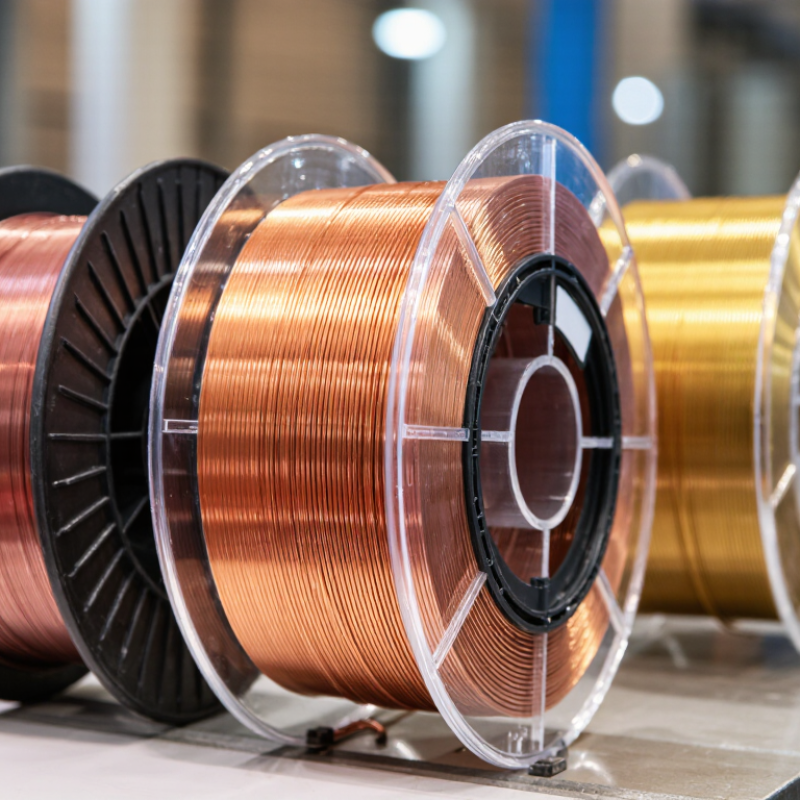
| Base Conductor | Electrolytic tough-pitch copper
Common designation: Cu-ETP / UNS C11000 | Electrical conductivity is typically specified at or above 100% IACS at 20°C for suitable conductor grades. Good availability, ductility, and cost balance. | ASTM B49 for copper rod for electrical purposes;
ASTM B187/B187M for copper bus bar and rod products;
IEC 60028 for electrical resistivity reference. | A practical default for general-purpose motor and transformer windings. Confirm oxygen level and suitability for the selected enamelling process. | Test resistivity or conductivity at 20°C, chemical composition, tensile strength, elongation, surface condition, and conductor dimensions. |
| High-Purity Conductor | Oxygen-free copper
Common designation: Cu-OF / UNS C10200 | Typically offers conductivity of approximately 100% IACS or higher, depending on grade and processing. Low oxygen content supports applications involving vacuum, hydrogen, or demanding thermal processing. | ASTM B170 for oxygen-free electro-deposited-refined copper; ASTM B49 and applicable national material specifications. | Usually costs more than standard Cu-ETP. Specify whether low oxygen content is technically necessary rather than using it as a general upgrade. | Review oxygen analysis, conductivity certificate, lot traceability, annealing records, and surface cleanliness. |
| High-Temperature Alloy Option | Copper-silver alloy
Typical composition: approximately 0.05–0.10% silver | Improved softening resistance and mechanical strength at elevated temperature compared with unalloyed copper, with some reduction in electrical conductivity depending on composition and temper. | Use the agreed chemical composition and performance specification; conductor dimensions and enamel requirements should follow the applicable IEC 60317 product part. | Consider for traction motors, aerospace-related equipment, compact high-temperature windings, or applications requiring improved thermal endurance. Confirm the actual alloy rather than relying on a generic “silver copper” description. | Verify silver content by a recognized chemical method, conductivity, softening behavior, tensile properties, and thermal-aging performance. |
| High-Strength Alloy Option | Copper-chromium or copper-chromium-zirconium
Used where strength and thermal stability are important | Higher mechanical strength and better resistance to softening than pure copper; electrical conductivity is lower and strongly dependent on alloy chemistry and heat treatment. | Specify the alloy composition, temper, and properties in the purchase specification. Use IEC 60317 for the enamelled-wire construction, where applicable. | Suitable only when mechanical strength, short-circuit resistance, or thermal stability justifies the higher material and processing cost. It is not automatically the best choice for ordinary windings. | Check alloy chemistry, hardness or tensile strength, conductivity, heat-treatment condition, and dimensional consistency. |
| Insulation System | Enamelled round copper winding wire
Polyester, polyester-imide, polyamide-imide, or other specified coating system | Thermal classes commonly include 155, 180, 200, and 220. The selected class indicates the insulation thermal rating under the relevant standard test system; it does not by itself define the complete motor or transformer temperature limit. | IEC 60317 series for particular types of enamelled wires; IEC 60216 series for evaluation of thermal endurance of electrical insulating materials. | Match the insulation to hot-spot temperature, impregnation varnish, refrigerant or oil exposure, mechanical abrasion, and inverter-induced voltage stress. | Verify thermal class marking, insulation build, dielectric breakdown voltage, flexibility, elongation, heat shock, abrasion, and pinhole performance according to the agreed product standard. |
| Conductor Size | Round wire diameter or rectangular conductor dimensions | The correct size is determined by current density, slot fill, winding resistance, cooling, and available winding space. Do not select by diameter alone when insulation build is critical. | IEC 60317 product standards for enamelled wire dimensions and properties; IEC 62433 or applicable customer drawings may define special constructions. | Specify nominal bare-conductor size, finished-wire size, tolerance, insulation grade, and whether the quoted dimension is bare or overall. | Measure multiple points using calibrated micrometers or laser gauges. Record bare diameter, overall diameter, ovality, and insulation concentricity where required. |
| Electrical Performance | DC resistance and conductivity | Resistance depends on conductor cross-sectional area, length, temperature, and alloy. Copper resistivity is normally referenced at 20°C; resistance rises as temperature increases. | IEC 60028 for resistivity of copper; IEC 60317 for applicable enamelled-wire requirements; ASTM B193 for resistivity and resistance of metallic materials. | Require resistance limits at a defined reference temperature and test length. Clarify whether the value is maximum resistance per kilometre or a calculated batch average. | Use a calibrated four-wire low-resistance meter, correct the result to 20°C, and compare with the approved drawing or purchase specification. |
| Mechanical Performance | Ductility, elongation, tensile strength, and winding capability | Soft or annealed wire provides better winding formability; harder tempers can improve handling and strength but may increase the risk of cracking or conductor damage during forming. | ASTM B3 for soft or annealed copper wire; applicable IEC 60317 mechanical tests for enamelled wire. | Select temper according to winding tension, bend radius, insertion process, and expected vibration. Require stable properties across the full coil or production lot. | Perform tensile and elongation tests, mandrel or flexibility testing, visual inspection after bending, and winding trials on production equipment. |
| Thermal Reliability | Thermal aging and heat shock resistance | The insulation system should withstand the specified thermal class, rapid temperature changes, and the customer's curing or soldering process without cracking or unacceptable dielectric loss. | IEC 60216 for thermal endurance evaluation; IEC 60317 for applicable heat-shock and thermal requirements. | Request compatibility data for impregnation varnish, resin, soldering temperature, and operating environment. Thermal class alone does not confirm chemical compatibility. | Review thermal-aging curves, heat-shock results, dielectric breakdown before and after aging, and insulation appearance under magnification. |
| Surface and Insulation Quality | Continuous, smooth, defect-free enamel coating | The wire should be free from scratches, blisters, bare spots, excessive lumps, contamination, and damaging diameter variation. | IEC 60317 applicable quality and test methods; customer-specific inspection plans may add pinhole or surface criteria. | Pay particular attention to high-speed winding, automatic insertion, sharp-edge slots, and repeated bending. Surface damage can cause turn-to-turn or turn-to-ground failures. | Conduct visual inspection, spark or pinhole testing where specified, insulation continuity testing, abrasion testing, and dielectric breakdown testing. |
| Supply Form | Spools, coils, drums, or continuous-length packages | Package selection affects handling, tension control, joint frequency, storage life, and automated winding efficiency. | Packaging is normally defined by the purchase specification and transport requirements rather than by one universal wire standard. | Confirm net wire weight, package dimensions, winding direction, permitted joints, flange condition, moisture protection, and identification labels. | Check package weight, length calculation, flange damage, label accuracy, joint records, and random unwinding performance before production release. |
| Documentation | Traceable quality documentation | Each shipment should be linked to a production lot and a defined material and insulation specification. | ISO 9001 may support the supplier's quality-management system; product compliance must still be demonstrated against the applicable IEC, ASTM, or customer specification. | Require a certificate of conformity, test report, lot number, manufacturing date, material designation, and storage instructions. | Compare the certificate with independent sample results and verify that the report covers the exact wire size, alloy, insulation grade, and production lot supplied. |
| Global Buying Decision | Best overall choice depends on application priorities | Cu-ETP: balanced cost and conductivity Cu-OF: low-oxygen applications Cu-Ag: improved high-temperature strength Cu-Cr/Zr: high mechanical strength | Build the purchase specification from the applicable IEC 60317 wire type, conductor material specification, dimensional drawing, and agreed inspection plan. | Compare total cost of ownership, not only price per kilogram: conductivity, winding yield, scrap rate, thermal life, package efficiency, delivery reliability, customs documentation, and technical support. | Approve samples through dimensional, electrical, mechanical, thermal, winding-process, and application-level testing before serial purchasing. |