2026 Best Robotic Gear for Industrial Automation
Industrial automation is moving from isolated robot cells toward connected production lines, where uptime depends on every component. The International Federation of Robotics (IFR), in World Robotics 2024, reported 541,302 industrial robot installations worldwide in 2023. The estimated operational stock reached 4.28 million units. The scale is real. Yet more robots do not automatically mean better production.
For 2026, choosing the best Robotic Gear means matching the transmission to the task, not chasing a headline specification. A compact planetary gearbox may suit a fast pick-and-place axis; a high-torque joint may need a different reducer, bearing arrangement, and lubrication plan. Engineers should compare rated torque, peak loads, backlash, torsional stiffness, speed, thermal limits, and service intervals. These details affect positioning accuracy and maintenance needs, especially when a robot repeats short, demanding cycles beside a conveyor.
This guide examines gear types and selection criteria for industrial robots, including collaborative, articulated, and material-handling systems. It also considers the complete drive train: motor, gearbox, controller, cabling, and mounting. IFR’s figures describe a growing installed base, not a guarantee of return on investment. That distinction matters. A gear that performs well in a catalog can disappoint under shock loads, poor alignment, or inadequate maintenance. We will compare practical strengths and trade-offs, while noting where published specifications leave questions unanswered. Builders should verify supplier data against real duty cycles and operating conditions before making a purchase.
Core Functions of Robotic Gearing in Industrial Automation
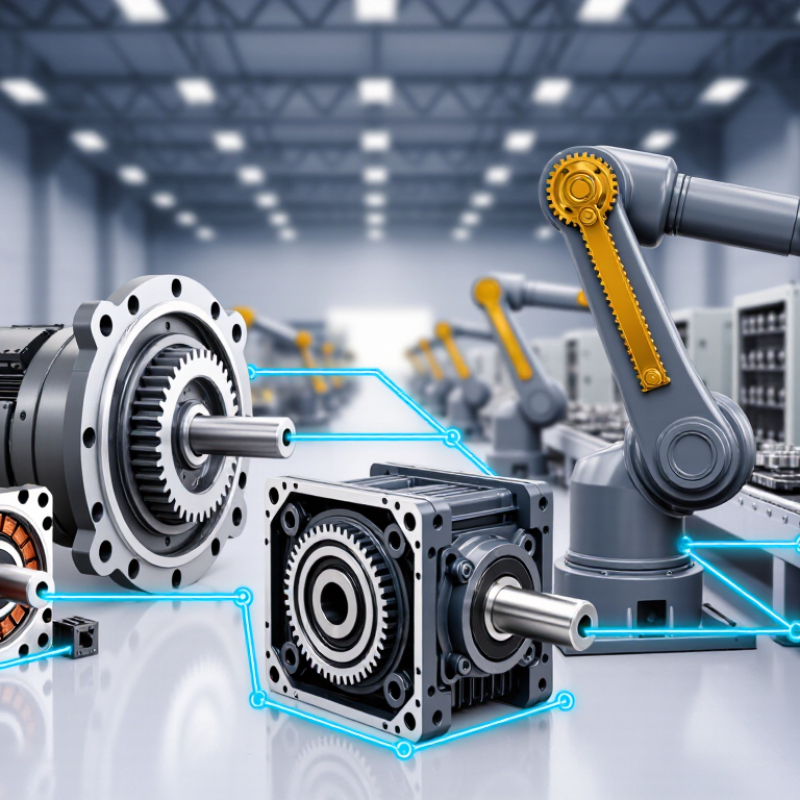
In industrial automation, robotic gearing controls how motor speed becomes useful joint motion. A reduction stage can multiply torque, allowing a compact motor to move a heavier payload. It also helps the robot hold position during tasks such as lifting a metal housing or guiding a tool along a fixed path. Smooth motion matters. Excessive backlash can cause small positioning errors, especially when a robot changes direction quickly.
Gearing also influences repeatability, energy use, and mechanical wear. Engineers match gear ratio to payload, reach, cycle time, and expected acceleration. A high ratio may provide strong output torque, but it can increase reflected inertia and slow rapid movement. Heat, vibration, and lubrication condition deserve attention during commissioning and routine checks. No gearbox is perfect. Even a well-selected unit may need adjustment when real production loads differ from test conditions.
Tips: Check backlash and temperature under normal operating loads, not only during an unloaded test. Record vibration and noise after installation, then compare readings over time. If motion becomes rough, inspect alignment and lubrication before changing control settings.
Main Gear Types Used in Industrial Robots
Industrial robots rely on gears to turn motor speed into controlled joint motion. Each joint has different loads, space limits, and accuracy needs. Planetary gearboxes offer compact, high-torque transmission, making them useful where mounting space is limited. Strain-wave gears provide high reduction in a small package, but their flexibility and wear sensitivity require careful sizing. Cycloidal reducers handle shock loads well and can suit joints where stiffness matters. Bevel gears redirect motion between intersecting shafts, while spur or helical gears may serve simpler stages.
Gear selection is not only about ratio. Engineers also check backlash, torsional stiffness, efficiency, noise, lubrication, and heat. A fast pick-and-place arm may prioritize low inertia and smooth reversals, while a palletizing joint faces heavier, changing loads. Even a well-rated gearbox can perform poorly if alignment is off or lubrication is neglected. That matters. Catalog figures rarely capture every duty cycle, and field measurements can reveal surprises. Some compromises remain.
Tips: Compare gear types against the joint’s actual speed, load, and motion pattern. Check backlash after assembly, and monitor temperature during repeated cycles. If measured performance differs from the design estimate, revisit sizing and alignment.
Key Criteria for Evaluating Robotic Gears in 2026
2026 Best Robotic Gear for Industrial Automation
Key Criteria for Evaluating Robotic Gears in 2026
Choosing a robotic gear starts with the motion profile, not a headline torque rating. Check peak and continuous torque against real acceleration, payload, and stopping demands. A gear may handle brief peaks but overheat during repeated cycles. Heat matters. Review backlash and torsional stiffness, especially for precise assembly or vision-guided positioning. Small errors can grow at the tool tip when an arm extends.
Also assess efficiency, noise, lubrication needs, and expected service intervals. These factors affect operating temperature and maintenance planning. Confirm that the gear fits the motor, mounting space, cables, and control system. Ask for test conditions behind published ratings; figures from different methods may not compare directly. A polished specification sheet can still miss the awkward part: vibration or shock from your actual machine.
Tips: Test a representative gear under your own load and duty cycle. Log temperature, positioning error, and noise over several shifts. Measure it twice. Include access for inspection when reviewing the design, since a hard-to-reach service point can turn routine maintenance into downtime.
Best Gear Options for Different Robots and Applications
The right robotic gear depends on the task, workpiece, and production environment. A small assembly robot may need a compact electric gripper with adjustable force. Delicate parts can deform under excessive pressure. Tiny components need careful handling. Vacuum cups suit flat, nonporous items, while uneven surfaces often call for mechanical fingers. Check the payload rating with the tool, cables, and workpiece included.
For palletizing, a high-payload robot paired with a secure parallel gripper can handle cartons more reliably than a lightweight tool. Heavy loads also make wrist stiffness and mounting hardware important. For welding, choose a torch mount and cable package designed for the robot’s motion path; poor routing can snag or wear. A collaborative robot may benefit from force sensing and rounded tooling, but these features do not replace a proper risk assessment.
Match the transmission and control system to the motion. Harmonic or planetary gear reducers can support precise movement, but the best choice depends on load, speed, duty cycle, and backlash tolerance. Dust, heat, and washdown conditions may change the specification. A useful check is to test the complete setup with real parts and realistic cycle times. Bench tests can miss awkward grip angles. Selection charts help, but they rarely capture every production wrinkle.
Integration, Maintenance, and Safety Considerations
Choosing robotic gear for industrial automation starts with the task, not the catalog. Map payload, reach, cycle time, and the space around each station. Check that the robot, gripper, sensors, and controller share compatible signals and communication protocols. Small mismatches matter. A gripper that clears a CAD model may still collide with a cable during a real cycle. Document handshakes, recovery steps, and expected cycle times before installation. Then test with actual parts. A perfect first layout is unlikely; revise assumptions when floor trials reveal awkward access or slower-than-expected motion.
Maintenance begins with a baseline. Record cycle counts, motor temperatures, vibration, and tool changes, then compare readings over time. Keep common wear parts and clear service instructions near the cell. Some wear hides. A loose connector, for example, can look like a software fault and waste hours. Safety needs equal attention. Assess pinch points, stopping distances, and access during setup, cleaning, and troubleshooting. Use guards, interlocks, and suitable presence-sensing devices where the risk assessment calls for them. Operators need training on safe recovery, not just normal operation. A rushed retrofit can leave gaps; schedule a review after the first weeks of production.



