Why Choose a 48V Electric Scooter for Your Fleet?
Fleet operators need vehicles that can handle repeated trips, short charging windows, and daily wear. NACTO’s 2023 Shared Micromobility in the U.S. and Canada report recorded 133 million shared micromobility trips across the United States and Canada that year. That figure signals substantial use, but it does not prove every fleet needs the same scooter—or battery voltage. Demand varies by route, weather, rider weight, and service area. Local conditions matter.
A 48v Electric Scooter can be a practical option for fleets seeking a balance of usable torque, speed, and battery-system compatibility. Higher voltage can reduce current for a given power level, which may ease electrical load in some configurations. Yet voltage alone does not determine range or performance. Battery capacity in watt-hours, motor and controller ratings, tire choice, payload, and charging practices all affect real-world results. Small details count: a steep block, a heavy delivery bag, or a battery left charging between shifts.
For procurement teams, compare tested range under realistic loads, charge time, parts availability, warranty terms, and service requirements. Ask suppliers how their figures were measured. NACTO’s trip data describes market activity, not the performance of any specific scooter model. That distinction is easy to miss. A fleet pilot can reveal what a brochure cannot: whether the scooter finishes its route, returns reliably, and stays economical after months of use. Voltage is a starting point, not a verdict.
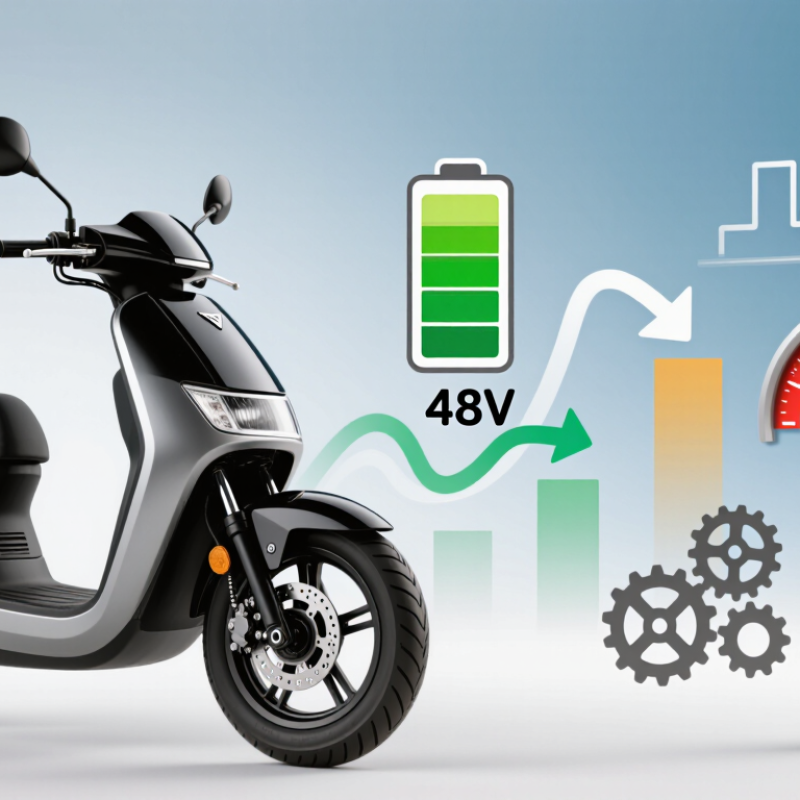
How a 48V Electric Scooter System Works
A 48V scooter system starts with a battery pack made from connected cells. In a series arrangement, cell voltages add up to create the pack’s nominal voltage. A battery management system monitors cell balance, temperature, and current. Depending on its design, it can limit output or disconnect power when readings leave safe ranges. Details matter.
When a rider turns the throttle, the controller reads the signal and meters current from the battery to the motor. More current can provide stronger acceleration, but it also creates more heat and uses energy faster. The controller, motor, battery, and wiring need compatible ratings. A poorly matched setup may feel jerky, even on a smooth warehouse floor. That is worth checking.
Under load, battery voltage naturally dips. Rider weight, hills, tire pressure, and frequent stops all affect range, so a fleet’s real results may differ from a specification sheet. Operators can compare battery charge levels across shifts and note which routes drain packs fastest. A consistent charging area helps, too, though charging routines are easy to neglect during a rushed handover. For fleet planning, the 48V label is only a starting point; battery capacity, controller limits, and maintenance records explain more about daily performance.