What Are the Best HDPE Floaters for 2026?
What Are the Best Hdpe Floaters for 2026? The answer depends on more than buoyancy. A floater must carry its working load, resist sunlight and repeated impacts, and remain practical to inspect and repair. A unit that looks sturdy on a showroom floor may behave differently when waves push it against a dock or when a loaded line pulls from one side. Small details matter.
The scale of plastics production gives useful context, but it does not prove that any specific floater will perform well. Plastics Europe’s Plastics—The Fast Facts 2024 reported 413.8 million tonnes of plastics produced worldwide in 2023. That figure covers all plastics, not HDPE or marine floats. For buyers, the useful comparison is product-level evidence: resin grade, wall thickness, UV protection, sealed-compartment design, rated load, and warranty terms. Ask for test results, not just a buoyancy claim.
One point needs care. No source article, interview, or verifiable expert quotation was provided, so I cannot responsibly attribute a direct statement to a named Hdpe Floaters specialist. A made-up quote would weaken trust. This guide therefore focuses on checkable specifications and practical selection criteria. It will compare common floater designs and explain which details deserve closer inspection before purchase. A better choice is usually the one whose limits are clearly stated. Not the flashiest one.
What HDPE Floaters Are and How They Work
What Are the Best HDPE Floaters for 2026?
What HDPE Floaters Are and How They Work
HDPE floaters are buoyant components made from high-density polyethylene, a tough plastic used in outdoor and water-contact applications. Many are molded as sealed units, trapping air inside to displace water and support a platform, pipe, or floating walkway. The material resists moisture and many common impacts, but performance depends on wall thickness, design, and workmanship. Not every floater suits every load.
Floaters work through buoyancy: their submerged volume pushes water aside, creating an upward force. A larger unit can generally support more weight, but only within its rated capacity and recommended operating conditions. Loads should be spread evenly; concentrated weight can tilt a dock or stress its joints. Connectors matter, too. Check how units attach, resist movement, and allow inspection or repair. I would not choose by appearance alone. A glossy shell can still hide weak seams or a poor fit.
Tips: Confirm the stated load rating and leave a safety margin. Inspect seams, fittings, and UV-protection details before purchase. Recheck after installation, especially where waves, shifting loads, or seasonal temperature changes are common. Small gaps can become annoying.
Key Features That Define a Quality HDPE Floater
What Are the Best HDPE Floaters for 2026?
Key Features That Define a Quality HDPE Floater
A dependable HDPE floater starts with traceable resin and consistent wall thickness. The Plastics Pipe Institute’s Handbook of PE Pipe gives a typical polyethylene density range of 0.941–0.965 g/cm³. That low density supports buoyancy, but it does not prove a finished floater’s load capacity. Ask for rated-load data and test conditions. ASTM D3350 classifies polyethylene using properties including density, tensile strength, and environmental stress-crack resistance. Those details help buyers compare material grades, not just surface appearance. Check welds, molded corners, and connector holes for thin spots or sharp edges. A neat finish matters; it is not the whole story.
UV resistance, sealed compartments, and impact tolerance deserve equal attention. Request documentation for UV stabilization and inspect samples after exposure or handling tests. A hollow floater should have reliable closures and a practical way to detect water ingress. Match its dimensions and connection system to the site’s waves, current, and maintenance access. I still find it easy to overvalue shell thickness; poorly supported fittings can fail first.
Tips: Ask for the rated load, resin specification, and UV test details. Press around joints and openings. Look for cracks, uneven walls, or loose closures. Keep a sample, if possible, and inspect it after a season in service.
Types of HDPE Floaters and Their Practical Uses
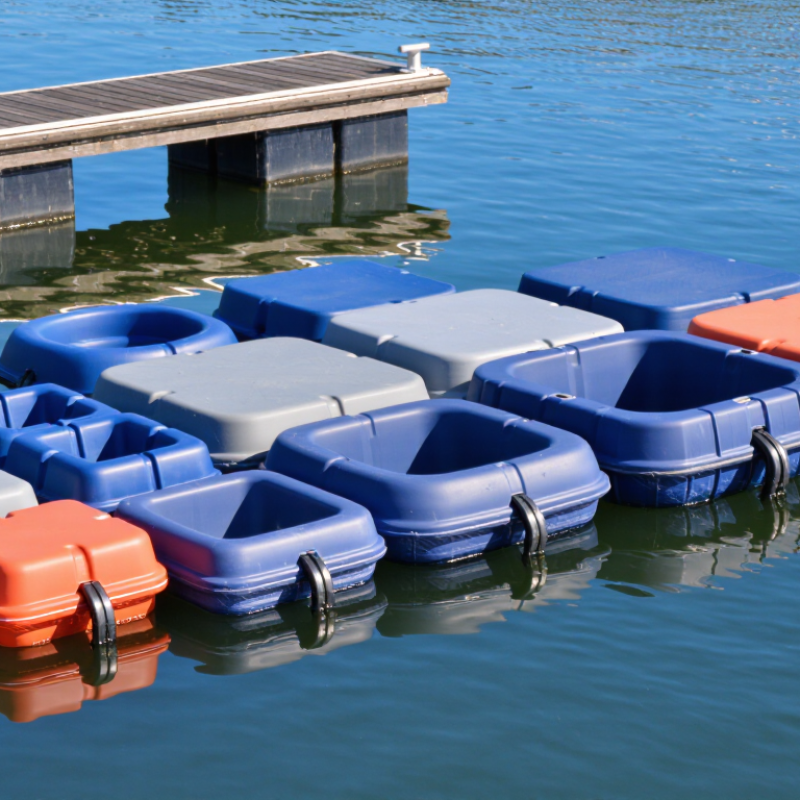
HDPE floaters serve different jobs, so shape and construction matter more than a generic “best” label. Hollow, molded pipe floats are common on aquaculture lines and floating pipelines, where their curved profile supports long runs with limited drag. Modular cube floats suit docks and temporary work platforms; individual sections can be rearranged around a shoreline or replaced after damage. For mooring and utility applications, cylindrical floats with sealed or foam-filled interiors offer another option. Small details matter.
The Plastics Pipe Institute’s Handbook of PE Pipe gives typical polyethylene density as approximately 0.941–0.965 g/cm³. That low material density helps HDPE shells displace water, but it does not reveal a floater’s safe working load. Check rated buoyancy, wall thickness, connection strength, and expected wave exposure together. A catalog rating can mislead if it assumes evenly distributed weight; a person stepping onto one corner changes the load. Foam-filled designs may remain buoyant after shell damage, though they can be heavier and harder to inspect. Hollow units are easier to assess, but leaks can reduce lift. For rough sites, inspect joints and seams regularly, not just the outer surface.
How to Compare HDPE Floaters for Different Applications
What Are the Best HDPE Floaters for 2026?
How to Compare HDPE Floaters for Different Applications
The right HDPE floater depends on its job, not just its advertised capacity. For a floating dock, compare rated buoyancy with the combined weight of people, decking, and equipment. Leave a practical margin for changing loads and rough water. Check the underside, too. A sharp rock or repeated impact can expose weak points.
For pipe support, prioritize steady lift, secure attachment points, and resistance to abrasion. Floats used in aquaculture may need smooth surfaces, stable positioning, and easy cleaning. In each case, inspect wall thickness, molded seams, and UV protection. Ask how performance was tested; vague capacity figures are hard to compare. Small details matter.
Site conditions shape the choice. Saltwater, cold winters, strong currents, and frequent handling place different demands on a floater. Modular units can simplify replacement, while larger sealed units may reduce connection points. Neither option is always better. I would compare samples or drawings against the actual load and installation plan before ordering. That step can feel slow, and calculations still rely on assumptions, but it helps reveal a mismatch before the floats reach the water.
How to Choose and Maintain an HDPE Floater in 2026
In 2026, the best HDPE floater is the one matched to its actual load and water conditions. Start by estimating the combined weight of the platform, equipment, and users. Then check the floater’s rated buoyancy and leave a reserve for uneven loading and waves. More capacity is not automatically better if the unit is bulky or difficult to secure. Ask for documentation on wall thickness, UV resistance, and temperature limits. Details matter.
Look closely at the shape and connection points. Broad, stable surfaces can suit floating platforms, while compact forms may fit narrow applications. Check that brackets and fasteners match the installation and resist corrosion in the local environment. A common oversight is planning for average conditions but not occasional heavy use. I would double-check that.
Maintenance is simple, but it should be regular. Rinse off mud, salt, and algae with fresh water and mild soap. Avoid sharp tools and harsh cleaners that could damage the surface. After storms or impacts, inspect for deep cracks, distortion, loose fittings, and unexpected water inside hollow units. Check connections again before seasonal use. Small damage can be easy to miss. Replace or professionally assess a floater if its buoyancy or structural condition is uncertain; visual inspection alone cannot confirm hidden damage.