


China Top Big LED Screen Supplier for Global Buyers?
China’s position as a leading Big Led Screen manufacturing base attracts buyers from retail, sports, transportation, entertainment, and public spaces. However, “top supplier” should mean more than a low factory price. It should reflect stable production, tested materials, responsive service, and documented project experience.
Leyard founder Li Jun has emphasized this principle: “The value of an LED display is measured by the experience it creates, not by its size.” For global buyers, that experience begins with technical choices. Pixel pitch affects viewing distance. Brightness influences outdoor readability. Refresh rate protects broadcast images from visible scanning lines. Cabinet weight affects installation time, transport cost, and structural planning. Weatherproof projects also require suitable IP protection, reliable power systems, and careful thermal management.
A dependable China supplier should provide clear specifications, sample testing, factory inspection access, and realistic delivery schedules. Ask for test reports, warranty terms, spare-parts planning, and regional technical support. Certifications may support compliance, but they should be checked against the destination market and actual product model. Do not rely only on polished showroom videos.
The lowest quotation can look attractive. It may also conceal weaker modules, uncertain calibration, or limited after-sales support. That risk deserves attention. A serious supplier explains both strengths and limitations. Buyers should compare total ownership cost, not only the first invoice. Site conditions, content requirements, installation skills, and maintenance access can change the final result.
This guide examines how global buyers can evaluate Chinese Big LED Screen suppliers with practical, evidence-based criteria. The goal is not to praise every manufacturer. It is to identify partners that can deliver visible quality, predictable support, and measurable long-term value.
What Makes China a Leading Supplier of Large LED Screens
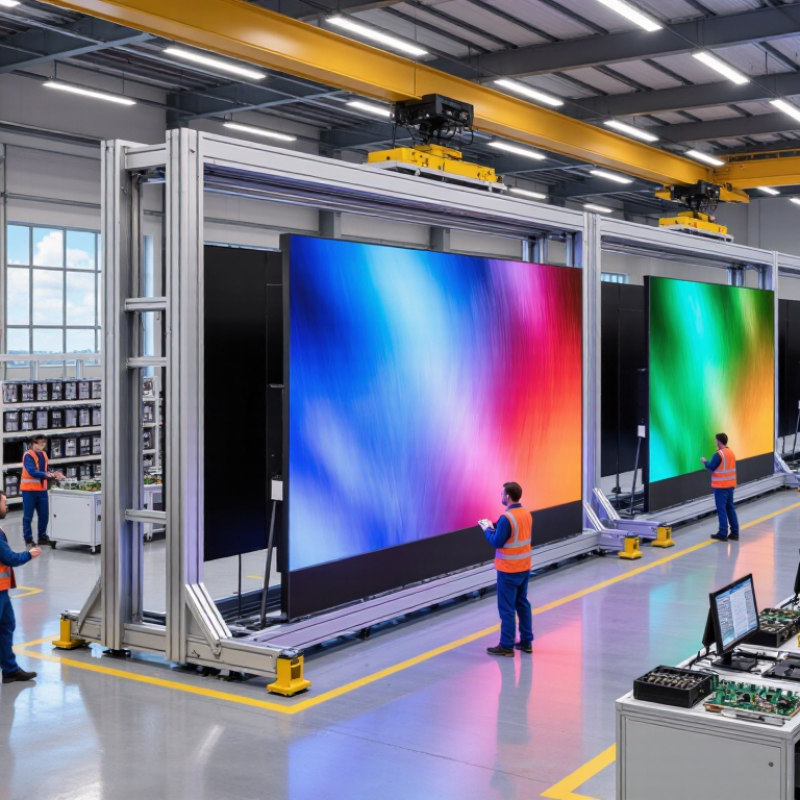
China has become a leading supplier of large LED screens through a dense manufacturing ecosystem. Component makers, cabinet producers, software engineers, and testing laboratories often operate within the same industrial regions. This shortens development cycles and reduces logistics costs. MarketsandMarkets estimates that the global LED display market will grow from about USD 7.4 billion in 2024 to USD 11.1 billion by 2029. Demand is increasing in stadiums, retail spaces, transport hubs, and outdoor advertising.
Chinese suppliers also offer practical customization. Buyers can specify pixel pitch, cabinet size, brightness, waterproof ratings, and maintenance access. Experienced factories usually provide sample testing, aging tests, spare modules, and installation guidance. Grand View Research reports strong market growth through 2030, supported by declining LED costs and wider commercial adoption. However, lower prices do not guarantee better results. Some suppliers still need stronger documentation, clearer warranty terms, and more consistent quality between production batches. That weakness deserves attention.
Tips: Request a complete technical sheet. Check brightness, refresh rate, IP rating, power consumption, and viewing distance. Ask for test videos under daylight and night conditions. Confirm whether replacement modules match the original calibration. A factory visit helps, but it is not perfect evidence. Independent inspection remains useful.
China Top Big LED Screen Supplier for Global Buyers? - What Makes China a Leading Supplier of Large LED Screens
| Evaluation Dimension | Typical Data or Range | Why It Matters to Global Buyers | Practical Purchasing Considerations |
|---|---|---|---|
| Application Coverage | Indoor, outdoor, fixed installation, rental and staging, sports venues, retail, transportation and control rooms | A broad product ecosystem allows buyers to source different display types for multiple environments and project sizes. | Confirm viewing distance, ambient light, weather exposure, installation method and operating hours before selecting a product category. |
| Pixel Pitch | Common large-screen options range from approximately 1.2 mm to 10 mm or more, depending on viewing distance and application. | Smaller pixel pitch generally provides higher image detail at close viewing distances, while larger pitch can reduce cost for distant viewers. | Choose pixel pitch according to the minimum viewing distance rather than selecting the smallest available pitch by default. |
| Brightness | Indoor displays commonly use several hundred to around 1,500 nits; outdoor displays often use approximately 4,000 to 10,000 nits or higher. | Sufficient brightness improves readability under ambient or direct sunlight conditions. | Ask for measured brightness, automatic brightness control, power consumption and compliance with local light-pollution requirements. |
| Refresh Rate | Many professional LED displays specify refresh rates from 1,920 Hz to 3,840 Hz or higher. | Higher refresh rates can reduce visible scanning lines and flicker when screens are recorded by cameras. | For broadcasting, live events and virtual production, verify refresh performance with the intended camera system and shutter settings. |
| Weather Protection | Outdoor cabinets are commonly specified with IP65 front protection; the rear rating depends on cabinet construction and ventilation design. | Ingress protection helps protect modules and electronics against dust and water exposure. | Check whether the stated IP rating applies to the complete cabinet, the front only or individual components. Review drainage and maintenance access. |
| Cabinet Construction | Aluminum cabinets are widely used for lightweight rental and fixed-installation designs; steel cabinets remain common for heavy-duty structures. | Material affects cabinet weight, heat dissipation, rigidity, transportation and installation requirements. | Compare cabinet weight, dimensions, module access, locking method, wind-load design and structural calculations. |
| Viewing Angle | Many LED modules provide a horizontal and vertical viewing angle of roughly 120 degrees, subject to LED package and mask design. | A wide viewing angle helps maintain consistent visibility for audiences positioned away from the screen center. | Request viewing-angle test data and evaluate brightness, contrast and color consistency across the intended audience area. |
| Serviceability | Front-service and rear-service designs are both available; front access is useful where rear maintenance space is limited. | Fast component replacement can reduce downtime and lower long-term maintenance costs. | Confirm spare-module compatibility, power-supply access, maintenance tools, service procedures and replacement time targets. |
| Color Performance | Professional displays commonly support 16-bit or higher internal processing, while actual color performance depends on calibration and system configuration. | Accurate grayscale and color uniformity are important for advertising, broadcast, signage and fine-detail content. | Evaluate grayscale at low brightness, cabinet-to-cabinet uniformity, calibration records and color-management compatibility. |
| Energy Efficiency | Power consumption varies significantly by pixel pitch, brightness, scan design, content and operating mode; maximum and average values should be requested separately. | Power usage affects operating expenses, electrical infrastructure and cooling requirements. | Use average power data based on realistic content rather than relying only on maximum power figures. |
| Customization Capability | Common customization areas include cabinet dimensions, curved or corner layouts, mounting structures, control systems, power input and environmental protection. | Flexible engineering can help adapt a display to architectural, transportation or event-specific requirements. | Require approved drawings, sample validation, tolerance limits and written confirmation of all customized specifications. |
| Production and Quality Control | Large LED display projects typically require module testing, cabinet assembly checks, aging tests, calibration and final inspection. | Documented quality procedures help reduce dead pixels, color inconsistency, connection faults and early failures. | Request inspection records, sample testing, burn-in duration, acceptance criteria and independent pre-shipment inspection when appropriate. |
| International Logistics | Large LED screens are commonly shipped as modules, cabinets, spare parts, control equipment and installation accessories. | Modular packaging can simplify transportation, replacement and phased installation. | Clarify package dimensions, gross weight, shock protection, delivery terms, customs documents and on-site unloading responsibilities. |
| Compliance Documentation | Depending on the destination, buyers may request documents related to electrical safety, electromagnetic compatibility, environmental requirements and product testing. | Proper documentation supports customs clearance, project approval and local regulatory compliance. | Check the exact requirements of the destination country and ensure certificates apply to the supplied configuration. |
| Warranty and Support | Commercial LED display contracts commonly define a limited warranty period, spare-parts policy and remote or on-site technical support. | Clear after-sales terms reduce operational risk over the display's service life. | Review warranty exclusions, response times, spare-parts availability, software support and responsibilities for installation-related failures. |
| Total Project Cost | Costs include LED cabinets, control equipment, structural support, shipping, installation, electrical work, commissioning and maintenance. | The purchase price alone may not represent the complete cost of ownership. | Compare quotations using the same pixel pitch, brightness, cabinet size, control system, accessories, delivery terms and service scope. |
