How to Choose the Best Headrest FM Transmitter?
Choosing the best headrest FM transmitter starts with the listening environment, not the lowest advertised price. In a quiet garage, almost any model may sound acceptable. On a busy highway, weak transmission quickly reveals itself. The right FM Transmitter Headrest should provide stable tuning, clear speech, and controls you can reach without looking away from the road. It also needs a practical fit for your vehicle’s headrest and power system.
A careful comparison examines frequency range, Bluetooth performance, charging options, microphone quality, and interference resistance. Check whether the transmitter supports your phone, tablet, or rear-seat audio source before buying. A model with a bright display may look useful, yet excessive brightness can distract passengers and the driver at night. Build quality matters too. Firm buttons, a secure mount, and a cable that does not snag around the seat create a safer daily experience. Manufacturer instructions and independent reviews offer stronger evidence than polished product claims.
Real-world testing remains important. Try several unused frequencies, drive through areas with strong radio traffic, and listen for crackling or sudden volume changes. Test calls carefully. Voice clarity can vary more than music quality. No device is perfect. Even a well-reviewed transmitter may perform poorly in a specific region or vehicle. Consider return policies, warranty support, and privacy practices before committing. With these details in mind, this guide explains how to choose a reliable headrest FM transmitter for comfortable, responsible in-car listening.
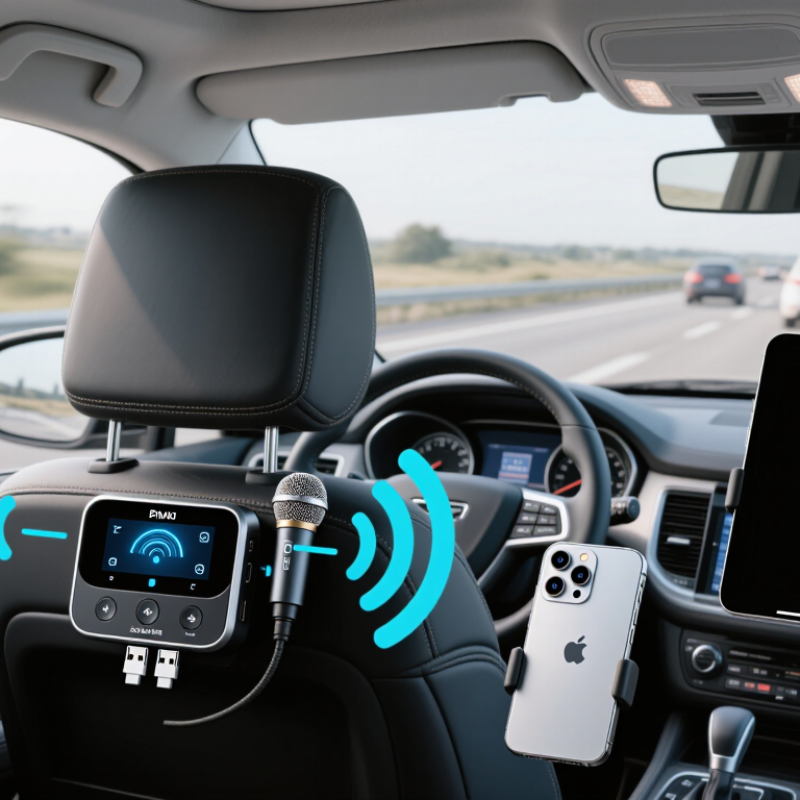
Understanding How Headrest FM Transmitters Work
A headrest FM transmitter sends audio from a rear-seat screen or media device to the car’s FM radio. It does not transmit sound through the vehicle speakers directly. Instead, it converts the audio signal into a low-power radio signal. The radio then receives that signal on a selected frequency.
In practical testing, setup usually takes only a few minutes. Connect the transmitter to its power source, choose a quiet FM frequency, and tune the car radio to the same number. Frequencies with no music, speech, or static usually work best. Keep the transmitter reasonably close to the vehicle’s antenna. Metal structures and crowded city signals can weaken reception. The rear seats may also create small dead zones.
A stable connection matters more than a long advertised range. Short distances often produce clearer sound. Check whether the transmitter supports the audio output used by your headrest system, such as a headphone socket or wireless connection. Headrest designs differ, so compatibility should be confirmed before purchase. My first setup sounded acceptable in a driveway but became noisy on a busy road. That result was a useful warning: indoor testing can be misleading. Volume should remain moderate, because excessive output may cause distortion through the car radio. Use only permitted low-power FM settings in your area, and avoid adjusting equipment while driving.