How to Choose the Best RFID Printer for Your Business?
Choosing the right Rfid Printer can influence label accuracy, workflow speed, and long-term operating costs. It is not simply a matter of selecting the fastest machine. Your decision should reflect daily label volume, tag size, material type, encoding requirements, and available workspace. A small warehouse may need a compact desktop unit, while a busy distribution center may require an industrial model with stronger durability.
Start by examining how the printer performs under real working conditions. Can it encode RFID tags consistently? Does it detect failed reads and alert operators clearly? Check print resolution, printing speed, connection options, and compatibility with your existing software. A printer that produces sharp barcodes but struggles with uneven tags may create costly delays. Testing several samples is wiser than trusting a product brochure.
User experience also matters. Operators should load media without confusion. Maintenance should not require specialist knowledge every week. Reliable technical support, firmware updates, warranty coverage, and replacement parts deserve careful attention. These details often appear minor.
They rarely are.
Cost needs a broader view. A lower purchase price may hide higher ribbon use, slower production, or frequent downtime. However, the most advanced printer is not automatically the best choice. It may be excessive for modest workloads and difficult for smaller teams to manage. This is where careful reflection helps. Estimate your current needs, then consider realistic growth. Choose equipment that supports your process without forcing you to pay for capabilities you will never use. A practical decision combines verified specifications, hands-on testing, staff feedback, and dependable supplier guidance.
What an RFID Printer Is and How It Works
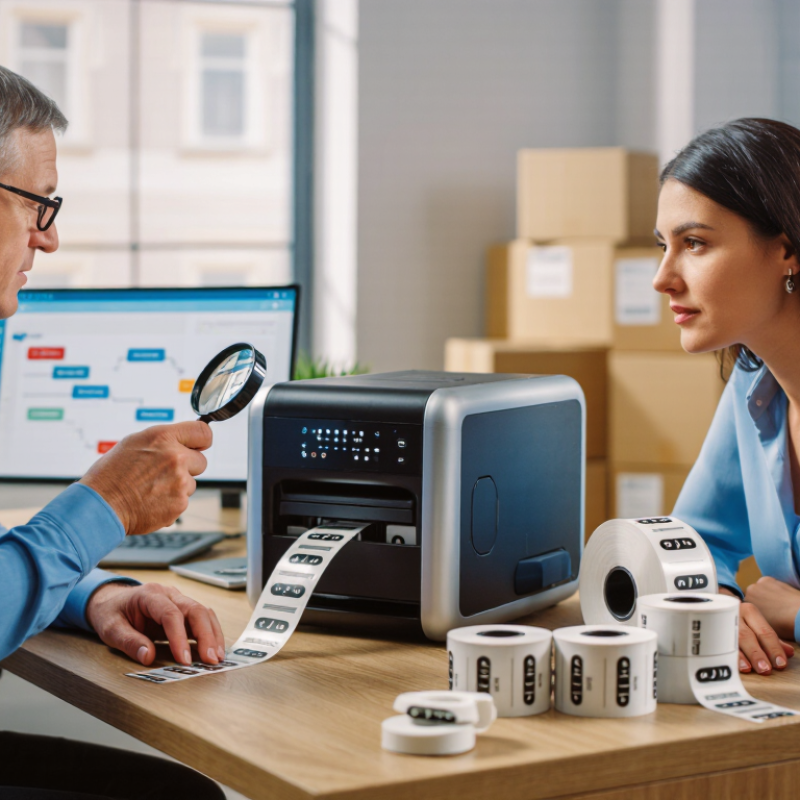
An RFID printer creates a readable label and stores digital data on its embedded chip. Unlike a standard thermal printer, it communicates with an RFID inlay during printing. The inlay contains a tiny antenna and memory chip. The printer encodes information, checks the response, and marks the label surface. If encoding fails, the system should reject that label instead of sending it into circulation. This process connects physical identification with inventory software.
When choosing an RFID printer, match its frequency, label size, and encoding method to your workflow. A warehouse handling cartons may need fast batch printing and durable synthetic labels. A laboratory environment may require smaller labels and careful readability checks. Ask whether the printer supports your existing software, database fields, and connection type. Throughput matters, but speed alone can hide errors. A practical test uses your actual rolls, surfaces, and print volume. Print one hundred labels. Test carefully.
Reliable RFID performance depends on placement. Metal, liquid, curved packaging, and tightly stacked products can weaken communication. Technicians should adjust antenna settings and verify encoded data before routine production. Keep rejected labels separate, and record the failure reason. One common assumption needs reconsideration: a clear printed image does not prove a successful RFID write. Read rates matter. The label may look perfect while its chip remains unreadable. Regular checks of print quality, read rates, and software logs reveal problems early. Small trials are less impressive, but they often prevent expensive rework.