


China Top 10 Blue Cut Lens Manufacturers
China’s top Blue-Cut Lens manufacturers serve eyewear brands, optical laboratories, and distributors with different priorities. Some focus on prescription lenses; others offer ready-made stock, customized coatings, or high-volume production. A polished catalog is useful, but it cannot show how a lens performs in a real order. Ask for clear spectral-transmission data, sample lenses, coating details, and batch traceability. Check whether reported results apply to the exact lens material and coating you plan to buy. Claims need checking. A blue-cut coating may change visible color or screen reflections, and it should not be treated as a cure for eye strain. Ophthalmologist Dr. Rahul Khurana has stated, “There is no scientific evidence that the light coming from computer screens is damaging to the eyes.” That perspective helps keep product claims in proportion.
This guide compares ten Chinese manufacturers through practical questions: What lens types do they make? Can they support your prescription range and order volume? How do they handle quality checks, samples, communication, and delivery? Request current documents rather than relying on a website badge or a single impressive photograph. If possible, compare sample lenses under the same lighting and ask suppliers to explain their test methods in plain language. A ranking is never perfect. Supplier strengths can shift with equipment, staff, and order requirements, and a small buyer may experience a factory differently from a large importer. Use the list as a starting point, then verify the details that matter to your own project.
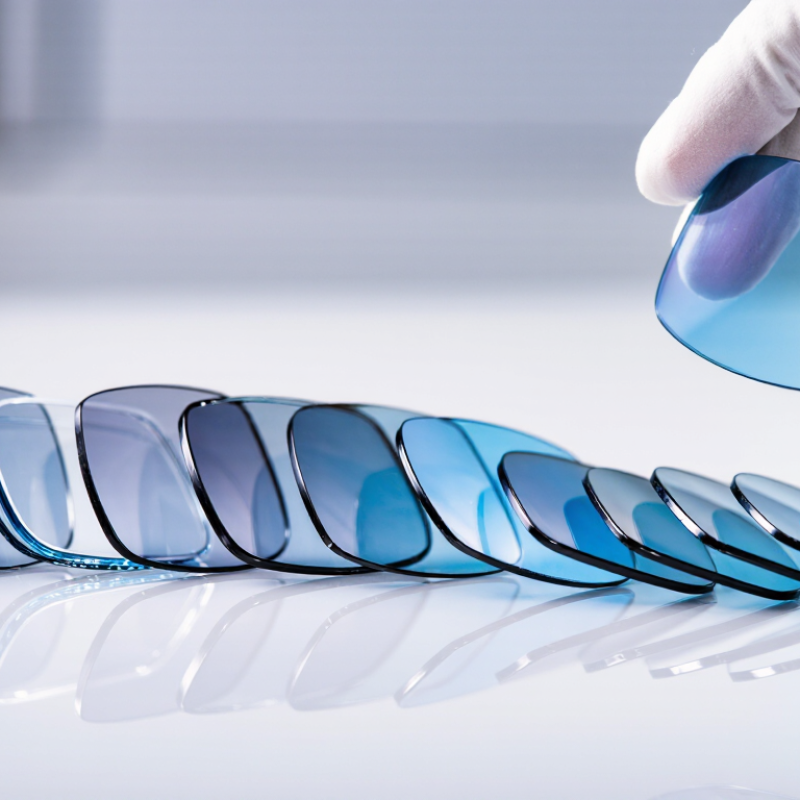
Blue-Cut Lenses Defined: The 380–500 nm Blue-Light Band
China Top 10 Blue Cut Lens Manufacturers
Blue-Cut Lenses Defined: The 380–500 nm Blue-Light Band
Blue-cut lenses are designed to reduce some light within a selected part of the visible spectrum. The 380–500 nm range is often used when discussing blue light, though its exact boundaries can vary between technical sources. Near 380 nm, light approaches the ultraviolet region; around 500 nm, it shifts toward cyan. These wavelengths are not a single, uniform exposure.
A lens may filter only a portion of this band, rather than blocking all blue light. Results depend on the lens material, coating, tint, and the wavelength being measured. Ask for a spectral transmission chart, not just a broad “blue-blocking” percentage. A chart shows how much light passes through at different wavelengths. The term can sound more exact than it is, and product claims deserve a careful look. Reducing blue-light exposure does not automatically prevent eye strain; screen glare, viewing distance, and long periods without breaks also matter.
Tips: Compare transmission data across 380–500 nm, and check whether figures describe the whole band or one wavelength. View the lens in neutral daylight, too. A strong tint may alter color perception, which matters for design work and other color-sensitive tasks.
