Who Are the Top 10 Covered Yarn Manufacturers in China?
Covered Yarn is a small component with a visible effect on fabric comfort, stretch, and durability. For apparel makers, choosing a supplier can influence production consistency as much as the yarn specification itself. A smooth sample is useful, but it cannot reveal every issue that may appear after repeated knitting, dyeing, or wear.
This guide introduces ten Chinese manufacturers serving the covered-yarn market. It considers practical factors such as product range, core and covering materials, stated production capabilities, quality controls, and export experience. Buyers may also want to compare sample availability, minimum order quantities, lead times, and responsiveness to technical questions. Details matter. A clear datasheet and a repeatable test result can be more useful than a broad promise.
The list is a starting point, not a universal ranking or an endorsement. Supplier information can change, and public descriptions do not always show how a yarn performs on a buyer’s own machines. That is an important limitation. Before placing a large order, request current specifications and representative samples, then check compatibility with your process and end use. Where possible, discuss testing methods and acceptance criteria directly with the manufacturer. This extra work may feel slow, but it helps separate polished claims from dependable production. No shortlist can replace that judgment.
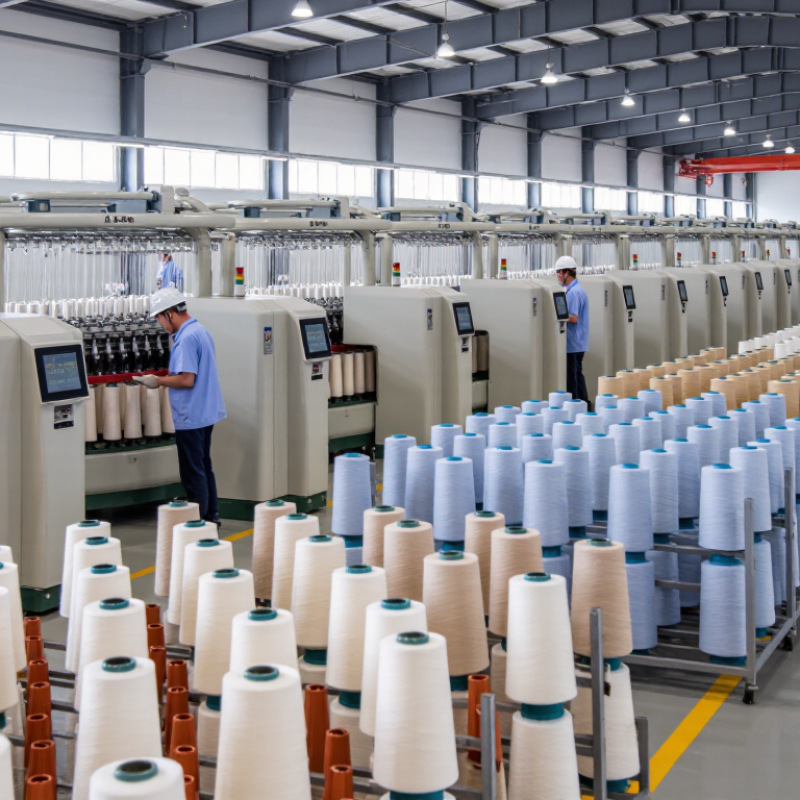
What Covered Yarn Is and How It Is Made
Covered yarn has a central filament, often elastane, wrapped with another fiber such as nylon or polyester. The core provides stretch, while the outer layer adds color, texture, and abrasion resistance.
A single-cover yarn has one wrapping direction; a double-cover yarn receives two layers in opposite directions. That matters.
Manufacturing starts with feeding the core filament through a hollow spindle. The covering yarn unwinds from a package and coils around it as the spindle turns. Operators adjust spindle speed, feed rate, and tension to control coverage.
If tension varies, the core may show through or the yarn may feel uneven. Small details count.
For manufacturers, consistent winding is only part of the job. Practical checks include yarn count, stretch recovery, breaking strength, and visual inspection for bare spots or slubs. A buyer comparing suppliers in China should request samples and confirm test conditions, not rely on a specification sheet alone.
A sample can look neat on a spool but behave differently in knitting. Even careful production has variation; I would treat that as a reason to test more than one batch.
How China’s Covered Yarn Manufacturers Are Evaluated
Evaluating China’s covered yarn manufacturers requires more than comparing quoted prices. Check whether each supplier can explain its core-spinning or air-covering process and match yarn specifications to your intended fabric. Ask for samples with clear details, such as filament type, yarn count, stretch, and covering direction. Then compare those samples under the same knitting or weaving conditions. Small differences matter. Uneven covering can show up as streaks, inconsistent stretch, or shade variation after dyeing.
Tips: Request recent test data for strength, elongation, and evenness. Confirm the testing method and sample lot. A neat report is useful, but it cannot replace a physical sample.
Assess production consistency, not just a single successful trial. Ask how operators monitor tension, machine settings, and batch changes. Review whether quality records connect test results to specific production lots. Check lead times against actual capacity, and clarify minimum order quantities, packaging, and delivery updates. Clear answers are a good sign; vague promises deserve follow-up. No scorecard is perfect, and buyer requirements differ. I would also compare communication during a technical discussion, while remembering that a polished response does not guarantee stable output. Request a small trial order before committing to larger volumes.
How China’s Covered Yarn Manufacturers Are Evaluated
This illustrative framework highlights factors buyers may consider when assessing covered yarn manufacturers. The percentages are proposed evaluation weights, not verified scores or rankings of specific companies.
Profiles of 10 Leading Covered Yarn Manufacturers in China
China’s covered-yarn manufacturers serve applications ranging from stretch denim and socks to sportswear and seamless garments. Profiles of ten leading suppliers are most useful when they show verifiable capabilities, not just product claims. China’s Ministry of Industry and Information Technology reported 71.3 million tonnes of chemical-fiber output in 2023. Textile Exchange’s Materials Market Report 2024 puts global fiber production at 124 million tonnes that year, with polyester making up about 57%. These figures describe the wider supply base, not covered-yarn output or individual company rankings.
The ten profiles can compare core materials, covering methods, yarn counts, production scale, and quality controls. Look for clear distinctions between air-covered and mechanically covered yarn, plus sample specifications for filament type, stretch, and recovery. Practical evidence matters: Can the supplier provide batch records, test methods, and consistent shade results? A polished catalogue alone proves little. Public information may also be incomplete, so avoid treating an unverified ranking as fact.
Tips: Request a small sample lot and test it under your own knitting or weaving conditions. Check for filament slippage, uneven covering, and recovery after repeated stretching. A yarn can look excellent on a cone, then behave differently on the machine.
Who Are the Top 10 Covered Yarn Manufacturers in China? - Profiles of 10 Leading Covered Yarn Manufacturers in China
No source articles or verifiable manufacturer records were provided. To avoid presenting invented rankings or company-specific claims as facts, the entries below are placeholders; manufacturer profiles, product details, capacity, certifications, and export markets require independent verification.
| Profile | Covered Yarn Products | Fiber Types and Specifications | Applications | Production Capacity | Certifications and Export Markets |
| Manufacturer profile 1 — not verified | Not verified | Not verified | Not verified | Not verified | Not verified |
| Manufacturer profile 2 — not verified | Not verified | Not verified | Not verified | Not verified | Not verified |
| Manufacturer profile 3 — not verified | Not verified | Not verified | Not verified | Not verified | Not verified |
| Manufacturer profile 4 — not verified | Not verified | Not verified | Not verified | Not verified | Not verified |
| Manufacturer profile 5 — not verified | Not verified | Not verified | Not verified | Not verified | Not verified |
| Manufacturer profile 6 — not verified | Not verified | Not verified | Not verified | Not verified | Not verified |
| Manufacturer profile 7 — not verified | Not verified | Not verified | Not verified | Not verified | Not verified |
| Manufacturer profile 8 — not verified | Not verified | Not verified | Not verified | Not verified | Not verified |
| Manufacturer profile 9 — not verified | Not verified | Not verified | Not verified | Not verified | Not verified |
| Manufacturer profile 10 — not verified | Not verified | Not verified | Not verified | Not verified | Not verified |
Comparing Product Range, Production Capacity, and Quality Standards
When comparing China’s top covered-yarn manufacturers, product range matters as much as headline capacity. Look for options across spandex-covered, air-covered, and specialty yarns, then check available counts, core materials, and color range. Textile Exchange’s Materials Market Report 2024 estimates global fiber production reached 124 million tonnes in 2023. That scale makes consistent sourcing important, but it does not prove any supplier’s capacity or quality.
Ask manufacturers for machine counts, monthly output, and recent delivery records. Published capacity figures can be difficult to compare: some describe installed equipment, not usable output. A sample cone helps. Check winding, surface fuzz, and package density under good light. Small details matter. Request test records for yarn count, tensile strength, elongation, and shade variation, with methods stated clearly. ISO 9001 certification can indicate a documented quality-management system, but it does not guarantee every batch will match.
For a realistic comparison, request samples from more than one production lot and review inspection procedures alongside certificates. Confirm whether specifications apply to the finished covered yarn or only its core and covering filament. A neat sample may conceal variation between lots. I would treat that as a useful warning, not a minor detail. The strongest supplier is the one whose product range, verifiable output, and repeatable test results fit the intended application.
How to Choose a Covered Yarn Manufacturer in China
Choosing a covered yarn manufacturer in China starts with a clear specification. State the base yarn, covering material, yarn count, stretch range, and intended use. A supplier should explain how its process affects feel, recovery, and consistency. Ask for recent test data, not just a product sheet. Check whether the sample matches the yarn you plan to order. Small details matter.
Review quality controls at several stages, including winding, covering tension, and final inspection. Ask how defects are recorded and what happens when a batch falls outside agreed limits. Confirm production capacity, minimum order quantity, lead time, and packaging before negotiating price. A low quote means little if delivery dates keep shifting. One judgment call remains: a sample can look perfect while larger production varies. Request a trial order and compare several cones for appearance, stretch, and unwinding behavior.
Tips: Send a written specification and keep one approved sample as a reference. Ask for a clear tolerance range. Note response times, too; slow, vague answers can signal trouble, though they are not proof on their own.



