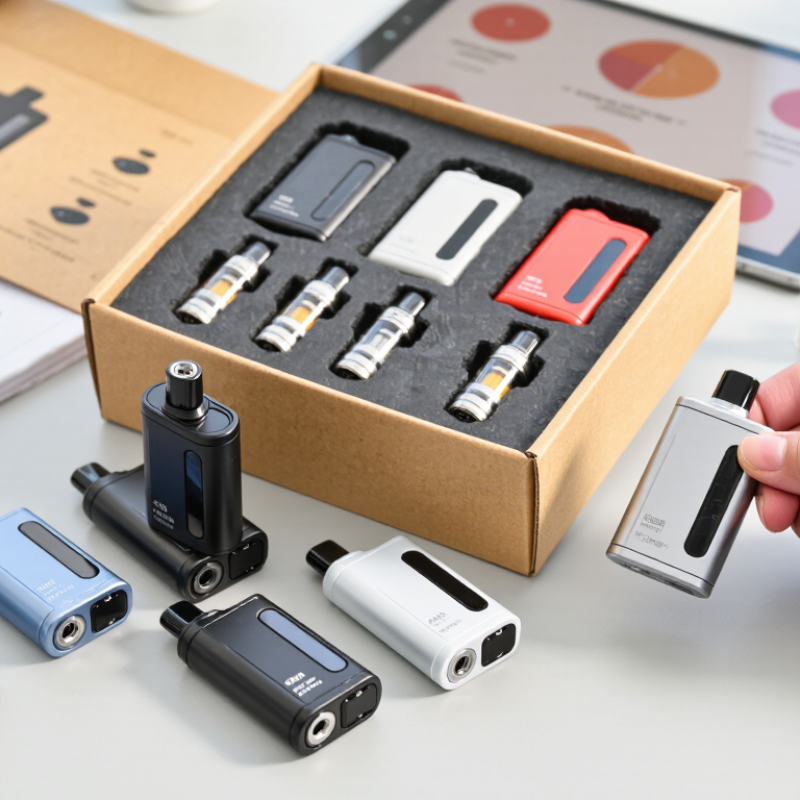
| 1 | Finished-device OEM | Complete vaping devices manufactured to a buyer’s specifications. | Business registration, manufacturing-site address, product specifications, quality-system certificates, and a sample contract identifying the legal manufacturer. | Audit production controls, incoming-material inspection, batch traceability, complaint handling, and change-control procedures. Verify certificates with the issuing body. | Check whether the exact product is lawfully marketable in the destination. A quality-management certificate alone does not authorize a product for sale. | Proceed only after a representative production sample passes documented functional, labeling, and applicable safety checks. |
| 2 | Private-label device manufacturer | Devices supplied with buyer-selected branding, packaging, or product configuration. | Written confirmation of product ownership, permitted branding rights, approved artwork, and responsibility for regulatory submissions and post-market issues. | Confirm that branding changes do not conceal changes to the device, components, or manufacturing site. Obtain samples from the intended production line. | Determine which party is the manufacturer, importer, or responsible economic operator under applicable local rules. | Do not approve artwork or production until product identity, responsible parties, and compliance responsibilities are explicit in writing. |
| 3 | E-liquid contract manufacturer | Formulation, mixing, filling, and packaging of e-liquids. | Ingredient specifications, batch records, safety data sheets where applicable, certificates of analysis, and documented supplier controls for ingredients. | Review mixing and filling hygiene, equipment calibration, lot coding, retained samples, and testing methods. Use an independent laboratory where appropriate. | Check ingredient restrictions, nicotine limits, notification or authorization obligations, warning labels, and packaging rules for each destination market. | Reject undocumented formulations or batches that cannot be traced to ingredients, production records, and test results. |
| 4 | Battery and power-system supplier | Rechargeable cells, battery packs, charging components, or related power systems. | Cell and pack specifications, test reports, safety documentation, and the applicable UN 38.3 test summary for lithium batteries offered for transport. | Check cell identity, protection-circuit design, charging limits, pack assembly controls, and consistency between tested samples and supplied goods. | Confirm transport classification, packaging, labeling, and carrier requirements. UN 38.3 transport testing is not a substitute for all product-safety obligations. | Do not accept battery documentation that cannot be matched to the exact cell, pack configuration, and shipment. |
| 5 | Heating-element and cartridge supplier | Coils, atomizers, cartridges, pods, and related components. | Material specifications, dimensional drawings, component declarations, and test data relevant to the intended device and use conditions. | Check fit, electrical characteristics, leakage performance, material consistency, and lot-to-lot variation with production-representative samples. | Assess applicable chemical, electrical, and consumer-product rules. Verify that component claims are supported for the exact material and configuration. | Approve only after compatibility and failure-mode testing with the intended device, liquid, and operating conditions. |
| 6 | Packaging and labeling supplier | Retail cartons, inserts, labels, warning panels, and tamper-evident packaging. | Final artwork proofs, material specifications, print-control records, and written confirmation of responsibility for version control. | Check legibility, durability, correct language versions, lot-code placement, and consistency between approved proofs and delivered packaging. | Have qualified local reviewers check required warnings, nicotine disclosures, age restrictions, recycling marks, and other market-specific labeling rules. | Hold production until the exact label version has been reviewed and approved for every intended sales jurisdiction. |
| 7 | Testing and compliance service provider | Product testing, chemical analysis, electrical testing, or regulatory documentation support. | Laboratory accreditation scope, test-method details, sample identification, complete reports, and any relevant ISO/IEC 17025 accreditation evidence. | Confirm that the report covers the exact model, formulation, components, and test conditions. Accreditation applies to specified activities, not automatically to every test. | Verify independently whether testing and documentation meet the destination market’s current requirements; a test report is not necessarily a marketing authorization. | Use reports only when the tested sample and production product are demonstrably equivalent and the report’s scope is relevant. |
| 8 | Export and fulfillment supplier | Export coordination, warehousing, shipping, and order fulfillment for legally saleable products. | Legal entity and warehouse details, shipping records, product-specific transport documents, and a written description of customs and delivery responsibilities. | Review inventory controls, storage conditions, stock rotation, shipment traceability, and procedures for damaged or recalled goods. | Confirm import eligibility, customs classification, taxes, battery shipping rules, and carrier acceptance for the actual shipment and destination. | Do not treat a supplier’s ability to ship as proof that the product may legally be imported or sold. |
| 9 | Multi-category trading supplier | Sourcing products from one or more factories and reselling them to buyers. | Full factory identity, authorization to sell, manufacturer details, supply-chain records, and documents issued for the actual product rather than a similar item. | Trace samples and purchase orders back to the production site. Confirm that substitutions require buyer approval and re-evaluation. | Independently validate certificates and reports with their issuers where possible. Clarify which party handles recalls, complaints, and regulatory inquiries. | Proceed only when the actual manufacturer, product version, and responsible parties are transparent and verifiable. |
| 10 | Custom product development partner | Design, engineering, prototyping, and manufacturing coordination for new or modified products. | Design ownership terms, technical files, change history, prototype records, risk assessments, and a written development and approval plan. | Require design reviews, verification testing, production validation, and formal approval of any material or component changes. | Establish early which market-specific submissions, notifications, or authorizations may be required before commercial sale. | Do not place a commercial production order until design changes, test scope, regulatory responsibilities, and acceptance criteria are documented. |