What Are the Top High Frequency Transformer Types in 2026?
In 2026, High-Frequency Transformers are central to compact power supplies, electric-vehicle chargers, data-center converters, and renewable-energy systems. Their appeal is clear: higher switching frequencies can reduce magnetic-component size. But the choice is not simple. Core material, winding geometry, insulation, operating temperature, and switching waveform all affect performance.
Power-magnetics researcher Charles R. Sullivan has published extensively on magnetic-component design. A practical paraphrase of his design-focused work is: “Choose the magnetic structure by balancing loss, temperature, and size—not frequency alone.” That distinction matters. A ferrite-core transformer may suit an isolated converter, while a planar design can provide a low profile and repeatable manufacturing. Nanocrystalline and amorphous cores may also fit specialized applications, though cost and operating conditions deserve careful review.
There is no universal “top” type. A transformer that performs well at 500 kHz in a controlled laboratory may run hotter inside a tightly packed enclosure. Small details count: winding proximity, insulation spacing, cooling airflow, and the copper’s skin-effect losses. They are easy to underestimate. This overview compares the leading transformer types expected to matter in 2026, including their strengths, limitations, and typical applications. Some rankings remain debatable, because product requirements differ—and published specifications do not always reveal real-world thermal behavior. The aim is a useful starting point, not a substitute for measured design validation.
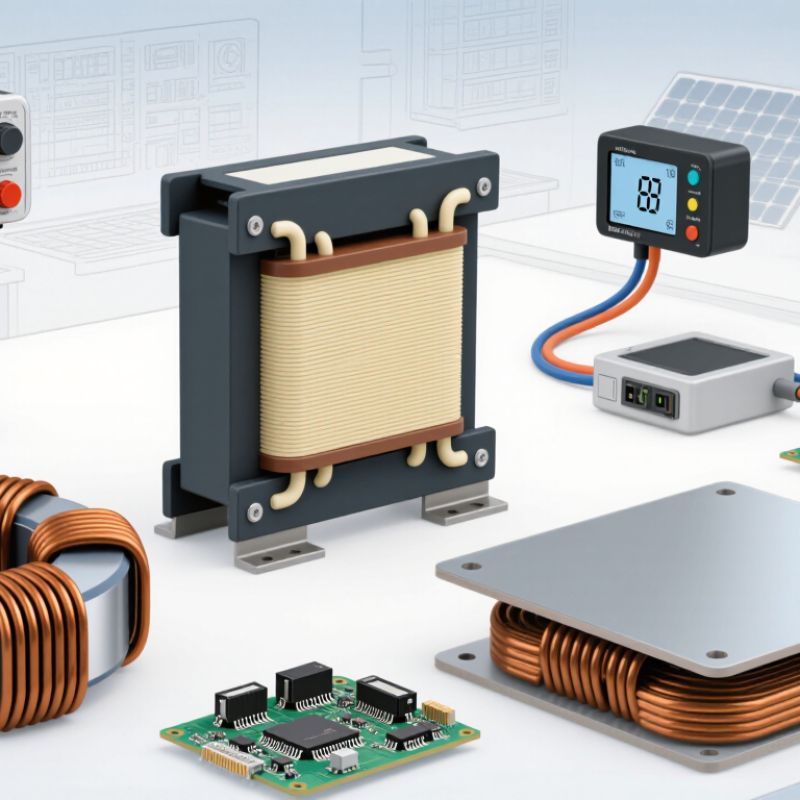
Definition and Operating Principles of High-Frequency Transformers
A high-frequency transformer transfers energy between electrical circuits using a changing magnetic field, typically at frequencies above the 50 or 60 hertz used by mains power. The exact frequency range depends on the application; switching power supplies commonly operate from tens of kilohertz upward. That is the principle. An alternating current in the primary winding creates changing magnetic flux in the core. This flux induces a voltage in the secondary winding, as described by Faraday’s law of electromagnetic induction. The transformer can change voltage and provide electrical isolation, but it does not normally change the signal’s frequency.
Higher operating frequencies can allow a smaller core and fewer winding turns for a given power level. But compact does not mean simple. Designers must manage core heating, insulation, leakage inductance, and losses caused by skin and proximity effects in the windings. Ferrite cores are common because they can limit eddy-current losses at high frequencies, though the right material depends on frequency, temperature, and power. In practice, a poorly matched core may run hot even when the output looks stable. Engineers check waveforms and temperatures under realistic loads, since layout and cooling can affect performance as much as the transformer’s nominal rating.