


2026 Top Mining Dredge Types Which Is Best?
Choosing the right Mining Dredge starts with the deposit, not the machine’s headline capacity. A cutter suction dredge can loosen compacted material, while a plain suction dredge may suit softer, uniform deposits. Bucket-ladder designs can handle demanding excavation, but they bring more moving parts to inspect. Each option has trade-offs. None is best everywhere.
This guide compares common dredge types by material, water depth, access, production needs, and maintenance demands. A narrow pond with fine sand presents a different challenge from a broad river channel with gravel. Hose length matters. So does the distance to the discharge point. Even a powerful pump can underperform when the layout is wrong. Check manufacturer specifications against site measurements and operating records, rather than relying on a single capacity figure. Field conditions can change that number.
The comparison also considers crew requirements, fuel use, wear components, and the practical effort of moving equipment between sites. Small details count. A worn suction line or frequent cutter-head blockage can erase expected gains. No table can replace a site assessment, and available information may leave uncertainty. That is worth admitting. The strongest choice is usually the dredge that matches the deposit and can be operated and maintained reliably, not simply the largest one.
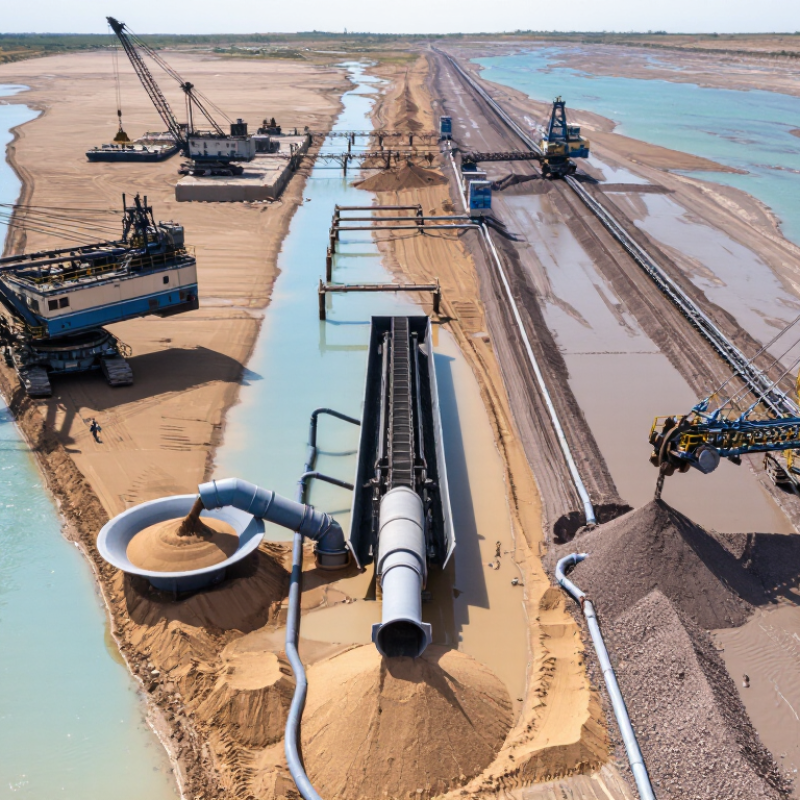
Define Mining Dredge Types by Excavation Method and Material-Handling System
Mining dredge types are best defined by two linked choices: how the deposit is excavated and how the material moves. A bucket-ladder dredge cuts and lifts dense or layered deposits mechanically. A cutter-suction dredge loosens material with a rotating head, then pumps it as slurry through a pipeline. For loose sand, a suction dredge may collect material directly; a hopper system can carry it away onboard. The distinction matters.
Mechanical excavation A bucket-ladder dredge cuts and lifts dense or layered deposits mechanically.
Hydraulic handling A cutter-suction dredge loosens material with a rotating head, then pumps it as slurry through a pipeline.
The U.S. Geological Survey’s Mineral Commodity Summaries 2025 estimates U.S. construction sand and gravel production at about
960 million tons in 2024.
That scale makes throughput, water availability, and discharge distance practical selection factors, not fine print. A pipeline suits steady production near shore, but long runs can increase pumping demands. Hopper handling adds mobility, though vessel capacity and unloading access may constrain output.
For abrasive, coarse feed, bucket systems can offer controlled excavation; for fine, pumpable deposits, hydraulic handling may move more material continuously.
No type wins everywhere.
I would test grain size, clay content, and slurry behavior before choosing; a neat classification still hides site-specific surprises. These distinctions align with USACE dredging guidance, while the USGS figure describes the market context, not dredge performance.
