


China Top 10 PCR Cosmetic Tube Manufacturers?
China’s cosmetic packaging sector is moving toward measurable circularity, not only attractive green claims. This guide examines China’s top 10 Pcr Cosmetic Tube manufacturers through a practical procurement lens.
The OECD reported that only 9% of global plastic waste was recycled in 2019. That figure exposes the gap between recycling ambition and actual recovery capacity. The Ellen MacArthur Foundation’s Global Commitment 2023 Progress Report also noted that participating organizations represented about 20% of global plastic packaging volume. These findings make PCR sourcing relevant, but they do not make every PCR tube automatically sustainable.
A reliable manufacturer should disclose PCR content, resin origin, batch traceability, and testing results. Look for evidence covering wall thickness, leak resistance, cap fit, color consistency, and decoration adhesion. A tube may look smooth under showroom lighting yet crack after repeated squeezing. Real performance matters.
This ranking considers production capability, export experience, quality systems, customization options, and documentation. ISO 9001 certification can support process control, but certification alone is not proof of superior PCR quality. That distinction matters.
The selection is not absolute.
Supplier strengths change with materials, order volume, and destination-market requirements. Some factories excel at laminated tubes, while others perform better with extruded PCR structures or low-volume customization. Buyers should request samples and independent test reports before approving mass production. Sustainability claims need verification. That is where professional judgment remains essential.
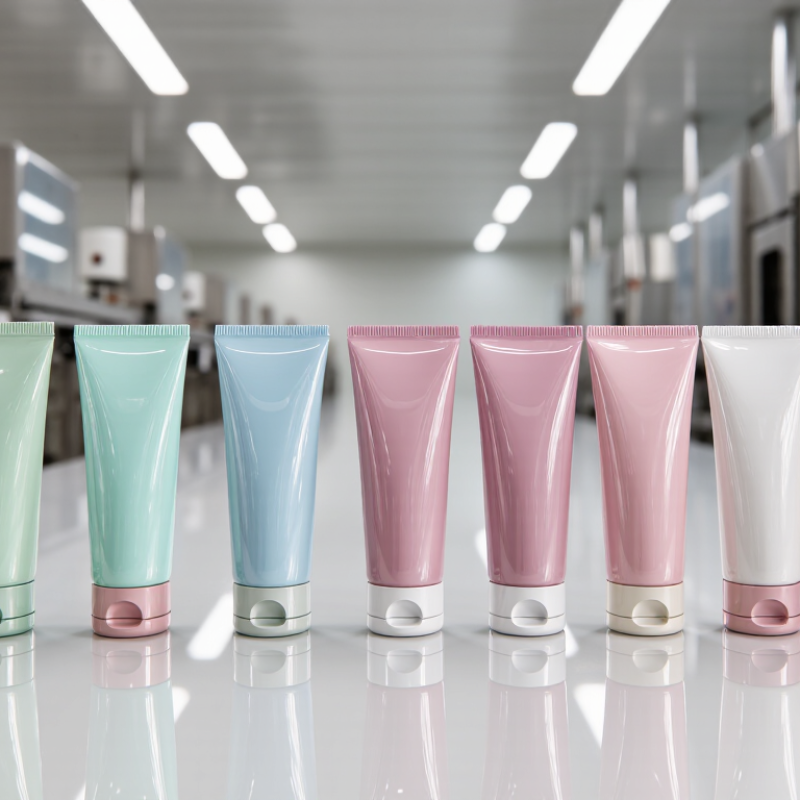
PCR Cosmetic Tubes Explained: 30%–100% Recycled PE Content Options
PCR Cosmetic Tubes Explained: 30%–100% Recycled PE Content Options
Post-consumer recycled (PCR) PE comes from used plastic collected, sorted, cleaned, and reprocessed. Cosmetic tubes may contain 30%, 50%, 70%, or 100% PCR PE, depending on structure and performance needs. The Ellen MacArthur Foundation’s 2023 Global Commitment report recorded average recycled content of about 6% across participating plastic packaging portfolios. Cosmetic tubes using 30%–50% PCR therefore exceed many market averages.
Performance changes with recycled content. PCR PE can show small color variations, specks, odor, or uneven gloss. Higher levels may also affect squeeze recovery, sealing strength, and print adhesion. Tube producers usually test wall thickness, cap torque, leakage, drop resistance, and product compatibility. A 100% PCR tube sounds ideal. It may not suit every cream, cleanser, or formula.
The OECD Global Plastics Outlook reported that only 9% of global plastic waste was recycled in 2019. Better packaging design still matters. Mono-material PE tubes can simplify recycling when labels, shoulders, and closures use compatible polymers. However, barrier layers can complicate recovery. Suppliers should request PCR origin, batch traceability, recycled-content verification, and migration testing. Certification helps, but it does not replace production trials. Small pilot runs often reveal problems hidden by laboratory samples. A practical specification should define acceptable color range, odor level, sealing temperature, and PCR percentage. Recycled feedstock is not perfectly consistent. That weakness deserves honest evaluation.
China Top 10 PCR Cosmetic Tube Manufacturers? - PCR Cosmetic Tubes Explained: 30%–100% Recycled PE Content Options
Technical comparison of PCR polyethylene content options for cosmetic tube packaging
| PCR PE Content Option | Typical Construction | Material Source | Appearance | Processing & Decoration | Barrier Considerations | Recommended Application |
|---|---|---|---|---|---|---|
| 30% PCR PE | Mono-material PE body or PE multilayer body with PCR blended into the applicable PE layer | Post-consumer recycled polyethylene, usually mechanically recycled and compounded before tube production | Generally the most consistent visual quality; light colors and high-opacity finishes are easier to achieve | Usually closest to conventional PE processing; suitable for offset printing, flexographic printing, labeling, and common surface treatments after validation | Barrier performance is mainly determined by the PE grade, wall structure, and any EVOH or other barrier layer rather than PCR percentage alone | Mass-market skin care, cleansing products, hand creams, body care, and introductory sustainable packaging programs |
| 50% PCR PE | PE tube body containing a higher PCR proportion; cap and shoulder may use separate PE or compatible recycled-content grades | Post-consumer PE recyclate with controlled melt-flow and contamination specifications | Natural, gray, beige, or slightly varied tones are common; opaque color matching is normally more practical than clear or highly translucent effects | May require tighter control of extrusion temperature, mixing, wall gauge, sealing, and print adhesion; production trials are recommended | Suitable for many non-volatile formulas, but oxygen, aroma, and moisture requirements should be checked using finished-package testing | Mainstream facial care, hair care, body care, and rinse-off products seeking a visible recycled-content claim |
| 70% PCR PE | High-PCR PE tube structure, commonly supported by a controlled virgin PE component for process stability and product-contact requirements | Higher proportion of post-consumer recycled PE; batch-to-batch traceability becomes increasingly important | Greater natural color variation, speckling, haze, and surface variation may occur, especially in lighter shades | More demanding control of extrusion stability, tube roundness, shoulder forming, trimming, welding, printing, and decoration consistency | Barrier or coextrusion structures may be needed for formulas sensitive to oxygen, fragrance loss, moisture, or light; compatibility testing is essential | Eco-focused skin care, professional hair care, cleansers, masks, and products where a natural or intentionally varied appearance is acceptable |
| 100% PCR PE | Tube body and, where technically available, compatible PE components made with recycled PE; exact percentage should be verified component by component | Post-consumer recycled polyethylene with documented input, processing, and mass-balance or physical-recycling records as applicable | Usually the greatest variation in color, odor, surface uniformity, and transparency; opaque and deliberately natural designs are generally more suitable | Requires robust incoming-material controls and production validation; decoration, sealing, dimensional tolerance, and visual consistency should be approved by sampling | PCR content does not automatically provide high barrier performance; use a validated barrier structure when the formula requires enhanced protection | Limited-edition, sustainability-led, or naturally styled packaging where maximum recycled content is prioritized over optical uniformity |
Key Evaluation Dimensions for PCR Cosmetic Tube Suppliers
| Evaluation Dimension | What to Verify | Why It Matters |
|---|---|---|
| PCR content documentation | PCR percentage by component, material declaration, batch traceability, and supporting recycled-content documentation | Prevents the tube body percentage from being incorrectly presented as the percentage of the complete package |
| Resin consistency | Melt-flow range, odor control, contamination limits, color variation, and incoming inspection procedures | Recycled PE properties can vary more than virgin resin and may affect extrusion and appearance |
| Tube structure | Mono-material PE, multilayer PE, EVOH barrier layer, wall thickness, shoulder design, and closure material | The structure affects recyclability, barrier properties, mechanical strength, and product compatibility |
| Formula compatibility | Migration, odor transfer, stress cracking, leakage, weight loss, and accelerated aging tests using the final formula | Cosmetic ingredients can interact differently with recycled and virgin polymer components |
| Decoration performance | Ink adhesion, rub resistance, color matching, varnish compatibility, labeling, and surface-treatment requirements | PCR variation may influence surface energy, print appearance, and color repeatability |
| Quality and compliance | Quality-management controls, applicable packaging regulations, restricted-substance controls, and product-contact assessment | Recycled materials require documented controls suitable for the intended market and cosmetic application |
| Sustainability claim | Clear distinction between PCR content, recyclable design, renewable content, and total package recycled content | These are different attributes and should not be used interchangeably in packaging claims |
