Best Red Light Therapy Manufacturers in 2026
In 2026, choosing a Red Light Therapy Manufacturer means looking beyond polished panels and confident claims. The market is expanding. Grand View Research’s Red Light Therapy Market analysis estimates the global market at about US$1.1 billion in 2023, with continued growth projected through 2030. Market estimates vary by product category and methodology, so they indicate commercial momentum—not proof that any device works.
Evidence and engineering matter. Photomedicine researcher Michael R. Hamblin describes photobiomodulation as using red or near-infrared light “to stimulate, heal, regenerate, and protect tissue” in his 2017 review in AIMS Biophysics. That scientific context is useful, but it does not validate every product or promise. Buyers should ask manufacturers for measured wavelengths, irradiance at a stated distance, treatment-area uniformity, thermal-safety details, and independent test documentation. A number printed on a box is not enough.
The manufacturers featured in this guide are assessed for product transparency, production capability, quality controls, and after-sales support. Look for clear specifications, traceable testing, and realistic guidance for use. Ask who measured the output—and under what conditions. That gap deserves attention. A supplier may offer attractive pricing yet provide little detail about testing or replacement parts. This is not a minor distinction. The strongest choice is not automatically the largest factory or the most persuasive brand. It is the manufacturer whose evidence, build quality, and service can be checked before the order is placed.
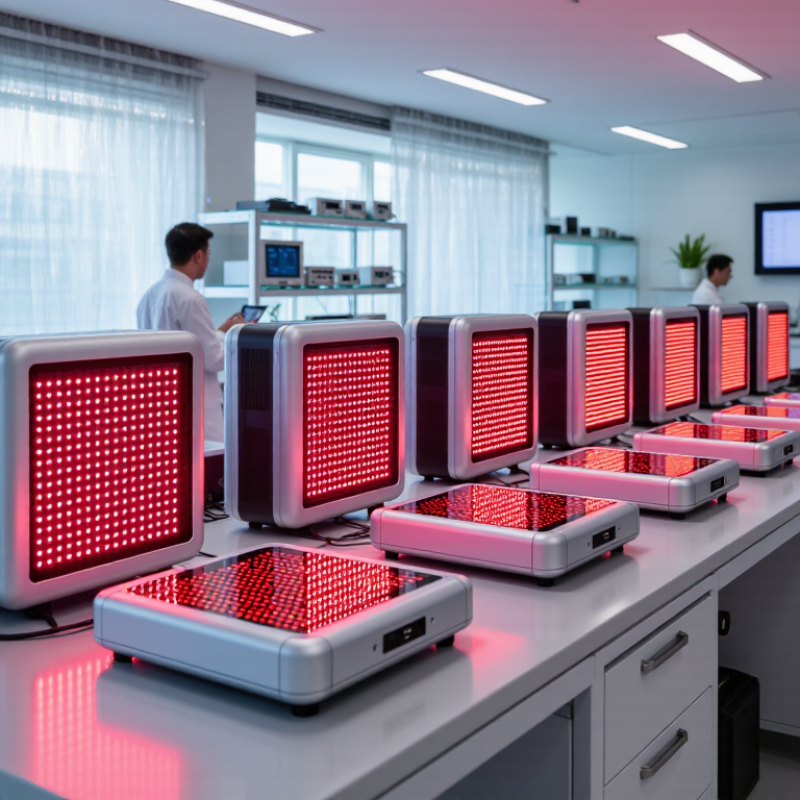
How Red Light Therapy Devices Work and Where They Are Used
Red light therapy, also called photobiomodulation, uses low-intensity red or near-infrared light. A 2016 review in AIMS Biophysics describes commonly studied wavelengths spanning roughly 600–1,100 nanometers. Light reaches tissue and interacts with cellular components, including mitochondria. This may influence energy production and signaling, but the response depends on wavelength, dose, and exposure time. More light is not automatically better.
In practice, devices are used for skin care, temporary relief of muscle soreness, and selected wound-care applications. A small treatment panel may sit above a clinic bed, while a handheld unit is used near the face or a sore shoulder. WALT’s photobiomodulation guidance emphasizes that dose depends on the treatment target and wavelength; readings such as milliwatts per square centimeter and joules per square centimeter help describe exposure. Details matter. Results vary, and research quality differs by use. Even careful protocols leave a practical gap: distance, skin characteristics, and device output can change the delivered dose. Red light is not a substitute for medical assessment, especially for persistent wounds or unexplained pain.
| Device Category | Common Light Bands | How the Device Works | Common Settings and Uses | Manufacturer Checks |
|---|---|---|---|---|
| Large LED panels | Red light commonly around 630–660 nm; near-infrared commonly around 810–850 nm. Some models offer both bands. | LEDs deliver light to a broad area. Photobiomodulation is thought to affect cellular signaling, including processes involving mitochondrial chromophores; the exact response depends on dose, wavelength, and tissue. | Home or professional wellness settings for broad-area exposure, such as the torso or limbs. Treatment distance and session duration vary by device. | Request measured irradiance at stated distances, wavelength and spectral data, electrical-safety documentation, clear operating instructions, and warranty terms. |
| Targeted handheld or small-area devices | Often use red wavelengths around 630–660 nm, near-infrared around 810–850 nm, or a combination. | A smaller treatment head concentrates light on a limited area. Delivered dose changes with distance, contact, exposure time, and the device’s measured output. | Designed for localized use. A device’s intended use and instructions should guide the treatment area and schedule. | Check output measurement methods, treatment-area size, timer controls, temperature management, and whether the product’s claims match its documented intended use. |
| Flexible face masks | Usually red light in the approximate 630–660 nm range; some include near-infrared bands. | Light-emitting diodes are positioned close to facial skin to provide relatively even exposure across the mask’s coverage area. | Consumer skincare routines. Eye protection and use around the eyes should follow the manufacturer’s instructions. | Look for clear fit and eye-safety guidance, validated output information, an automatic timer, skin-contact material details, and cleaning instructions. |
| Full-body beds or multi-panel systems | May combine red and near-infrared bands, commonly within the ranges of 630–660 nm and 810–850 nm. | Multiple emitters expose a large body area. Larger coverage does not by itself establish a particular clinical benefit; dose and protocol remain important. | Found in some clinics, studios, and specialized facilities for full-body exposure. Session protocols differ among products and settings. | Evaluate coverage uniformity, cooling and emergency shutoff, electrical certification, maintenance requirements, and independent output testing across the treatment area. |
| Clinical photobiomodulation equipment | Wavelengths vary by device and intended use; red and near-infrared bands are common. | Delivers a specified light dose under a defined protocol. Evidence and authorized indications are specific to the device, condition, and jurisdiction. | Used by trained professionals for indications permitted by the applicable regulatory authorization and product labeling. | Verify the exact model’s regulatory status and intended use in the relevant market, clinical evidence, dose controls, user training, and service support. |
Selection note: Wavelength ranges shown are common examples, not universal specifications. Irradiance, dose, treatment distance, and session duration vary substantially between devices. Red light therapy is not a substitute for medical diagnosis or treatment; consult a qualified healthcare professional about health concerns.